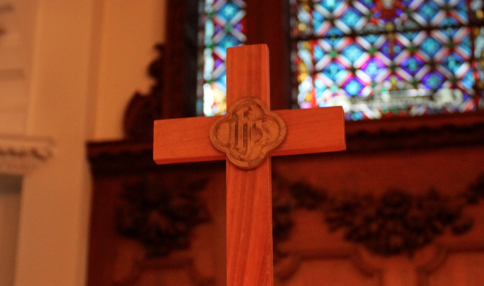
The Trinity: Life Together

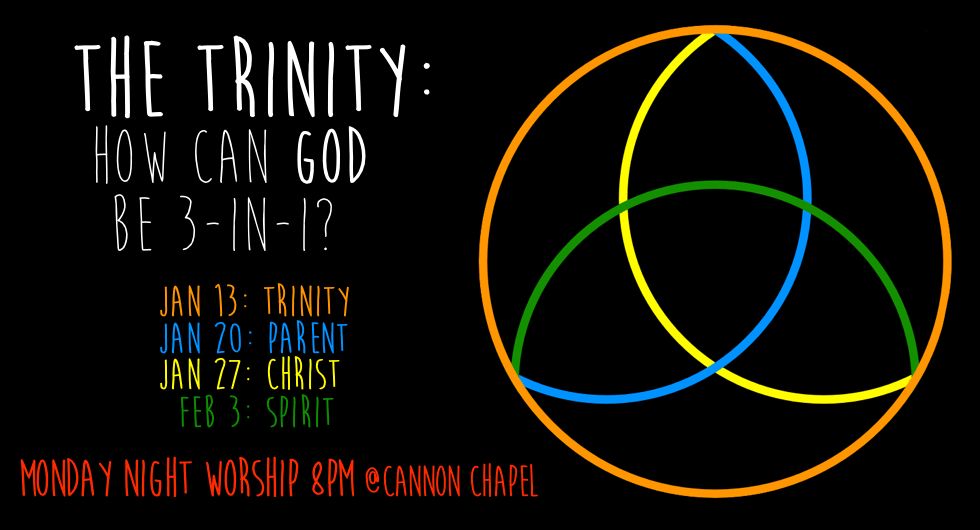
Last semester, the student leaders at Emory Wesley and I met and decided that we should cover some pretty exciting topics in Monday Night Worship this semester–“The Trinity,” “Race and the Church in America,” and during Lent: “The Long March to Redemption” (hooking off of Mandela’s “Long Walk to Freedom” and other social justice influences partnered with Jesus’ walk to the cross in Lent).

For the first series on the Trinity, we’re going to be doing a 4 part series on The Trinity with staff and students Screen Shot 2014-01-06 at 5.04.10 PMgiving homilies on the overall Trinity and the 3 persons of The Trinity. The students are excited about the series and are really engaging well with the topic, songs, and the way we’re addressing this theological behemoth. We’re not trying to answer all the questions, but really we’re trying to help students ask the RIGHT questions. We’re halfway through the series and things are going pretty well thus far.

Here’s the first night of the series where I preached about how the Trinity shows us how God is in relationship and we must also seek to be in relationship in a homily called “The Trinity: Life Together.”

01.13.14 Monday Night Worship // ” The Trinity: Life Together” from Emory Wesley on Vimeo.

BikeToWork (ecology/theology)

Being a bike commuter is a way to live out my ecological and theological beliefs to take care of the planet and to care for people.

I’ve always liked bike riding. From childhood to college & grad school I’ve biked occasionally for recreation, transportation, exercise, and fun. This year I’ve been able to take on a new adventure: biking to work 2 days of my 4 day work week. I’m riding a bike rented from an innovative program Bike Emorya unique partnership between Emory University & our local shop Bicycle South that encourages/equips students, faculty, and staff to learn bicycle care, make community connections, and ride safely.emory bike

I believe in bike commuting as a way to lessen my impact on the environment, improve traffic, and see the world in a more people-centric, community kind of way. Riding to work allows me to lessen the amount of greenhouse gases I’m contributing to the atmosphere, take one single-commuter car off the road, and to see different side streets, neighborhoods, people, and communities that I otherwise wouldn’t see.

We have amazing Sustainability Initiatives at Emory, which really help our community to engage in greener ways of living and enjoy the world around us. In my work as the United Methodist Campus Minister at Emory I have had so many good conversations with students about how we are called to take care of the environment as a matter of justice, stewardship, and a way to care for people. In my faith tradition we have 3 simple ‘rules’: “Do Good, Do No Harm, and Stay in the Love of God and Neighbor.” These seemingly simple rules are more complex once we take them beyond simple platitudes and ask how to live out these ideals–especially when we consider how we live, act, and use/consume resources.

Socrates got it right when he said that “an unexamined life is not worth living.” This is one of the greatest challenges for Americans: to think beyond our own needs and to consider the needs, situations, and hopes of others in our communities and in other communities in our nation and around the world. A step towards understanding the hopes and needs of others is to get to know people who are in different ages, stages, and economic places in your community. In the context of relationship we can learn much about the hopes, dreams, and ideals of others and, in turn, discover much about ourselves.

Riding a bike makes one physically and philosophically closer to world around us: there is no emory road blurredglass/metal cage to separate us, no radio to distract us, no anonymity of a car to shield us. Riding my bike to work gives me time to take in and ponder the people and scenes I’m seeing and hearing–not to mention the hills that I’m feeling in my legs. I’m thankful to be able to bike to work to better understand and appreciate the world around me. Being a bike commuter is a way to live out my ecological and theological beliefs to take care of the planet and to care for people.

__

twitter bio shot 2012 3Rev. Joseph McBrayer works as Director of Emory Wesley Fellowship, the United Methodist Campus Ministry at Emory University in Atlanta, Ga, where he helps build community on campus to provide a place for students to think through their beliefs and put them into practice. He and his spouse live in the North Decatur area and have been a part of the Atlanta/Emory Community for the past 8 years. You may contact him at jmcbray@gmail.com or connect on twitter @jmcbray.

faithful mentors

I’m writing this post today in response to a DAY OF BLOGGING for Exploration 2013, a United Methodist Event for people discerning a call to ordained ministry. They asked us to respond to the question: “Who influenced you in discerning your Call to Ministry?” So here it is:

For many in ministry or clergy roles we simply “walk alongside” and  “live life” with the people whom we guide and work with in ministry. This is what the many faithful mentors in my journey have done with/for me–they’ve simply been there as I have experienced (thus far) the full stretch of human life–good times and bad.

auburn samford hallMy specific call to ministry and working with college students came during my freshman year at Auburn University when I went on a Weekend Mission Trip with Auburn Wesley Foundation and Alabama Rural Ministry (ARM) to Mobile, Alabama to work at St. Francis Street Mission. The trip was led by Lisa Pierce, the founder and director of ARM

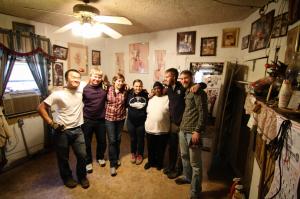
On the trip we worked with a man named “Mr. Johnny” where we fixed his roof and shared some good times and even a few jokes about coffee, roofing, and life. On Sunday morning instead of GOING to Church we went and DID Church: we worked in the soup kitchen and sang songs with the men, women, and children, the poor and homeless, who were in the mission that day. It was an eye opening experience to DO Church instead of just attending church/worship on Sunday morning.Emory Wesley students at ARM on Spring Break 2013 I came back from that trip feeling called and knowing that I wanted to do those kinds of things, and help others to do those things as my vocation. Lisa’s facilitating that trip and encouraging me to go has helped shape the direction of my life for the better. We still stay in contact and it is a great joy to bring Emory Wesley college students on trips to do work with Lisa and ARM.

Over the course of my time at Auburn the Auburn Wesley Director, Rev. David Goolsby, guided and mentored me in ministry and helped shape me into a leader in the Auburn community. I had the opportunity to help lead music and liturgy in worship, experiment with different styles and types of worship, lead small groups, reflect theologically and dream about church models, plan and lead mission trips, and many more opportunities for transformation and service. David is still a mentor of mine, officiated our wedding, and is a thoughtful guide and ‘guru’ of campus ministry for many.

I am thankful and grateful to God for mentors like Lisa and David who helped me to hear God’s call in my life. I’ll end with a word from David in my own paraphrased Goolsby-ism: “May we seek to be faithful to God as God is faithful to us.” Amen.

For more info about Exploration 2013 click here: ExploreCalling.org!

Emory Wesley Orientation Video

Orientation Video 2012: Students sharing about the importance of Emory Wesley Fellowship, the United Methodist Campus Ministry at Emory University.

Here is the quick video introduction to Emory Wesley Fellowship, the United Methodist Campus Ministry at Emory University: (students on Facebook here  ||  Twitter here  || Alumni, friends, parents, supporters FB page

music: “Festival” by Sigur Ros used under fair use regulations and this statement by the band: http://www.sigur-ros.co.uk/banda/faq.php#13

“This is My Song” (July 4th)

The hymn “This is My Song” serves as a reminder of the love God has for all people–not just for this nation or another nation. On this July 4th, may we be mindful of all the people in this nation and other nations who are still striving for justice and for peace.

The Fourth of July brings up many themes of patriotism: we celebrate our United States of America and demonstrate our pride in our nation–there are some instances of appropriately and carefully crafted celebration and pride, while other instances seem to exalt our nation over and against all other nations. The hymn, “This is my song” reminds us that ALL nations are loved by God and that we as individuals or as a nation do not have any more or less favor in God’s eyes. As the author puts it, it is “a song of peace for lands afar and mine.” The familiar tune Finlandia , by Finnish composer Jean Sibelius, was written in 1899, as a covert protest against the oppressive Russian forces, and is a much beloved symphonic piece.

The 4th of July began as a day of celebration of our independence from the tyranny of the British empire upon the American colonies. Those many years ago our forefathers and foremothers gave birth to a land where religious and political freedoms were guaranteed and that all people had civil rights (although we are *still* working on getting these parts right some MANY years later).

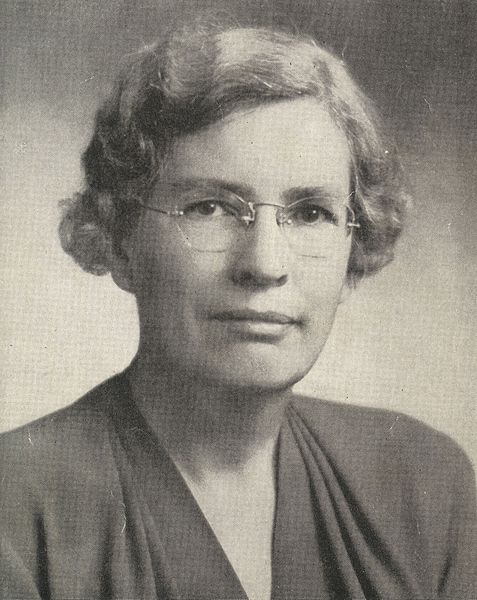
The first two verses were written by American poet Lloyd Stone who wrote a number of books of poetry, two children’s books, and served as chapter president of the National Society of Arts and Letters. The final verse was written by Methodist theologian Georgia Harkness, who was one of the first women to hold a full professorship at a U.S. theological seminary--she taught at Garrett & Pacific School of Religion to name a few. Harkness was a leader in the ecumenical movement and was important in securing ordination for women in the Methodist Church. Most of her hymn writing was in the form of prayers and the final verse of “This is My Song” is a fine example of her work and her prayer for God’s peace to be known in “all earth’s kingdoms.”

Below is my own arrangement of “This is My Song,” which serves as a reminder of the love God has for all peoplenot just for this nation or another nation. On this July 4th, may we be mindful of all the people in this nation and other nations who are still striving for justice and for peace. “Si quieres paz, lucha por la justica” “If you want peace, work for justice.” –Pope John Paul II

“This is My Song” Lloyd Stone/Georgia Harkness, 1939 // UMHymnal #437, Finlandia, 1899 , J. Sibelius
This is my song, Oh God of all the nations,
A song of peace for lands afar and mine.
This is my home, the country where my heart is;
Here are my hopes, my dreams, my sacred shrine.
But other hearts in other lands are beating,
With hopes and dreams as true and high as mine.

My country’s skies are bluer than the ocean,
And sunlight beams on cloverleaf and pine.
But other lands have sunlight too and clover,
And skies are everywhere as blue as mine.
Oh hear my song, oh God of all the nations,
A song of peace for their land and for mine.

This is my prayer, O Lord of all earth’s kingdoms:
Thy kingdom come; on earth thy will be done.
Let Christ be lifted up till all shall serve him,
And hearts united learn to live as one.
O hear my prayer, thou God of all the nations;
Myself I give thee, let thy will be done.

the chord sheet of this arrangement: This Is My Song (Finlandia in C)
(fair use)

*resources used:
the Commentary on the United Methodist Hymnal by Carlton Young
The Hymns of the United Methodist Hymnal by Diana Sanchez
Wikipedia (mostly the sources in the footnotes!)

Wade In the Water (live)

A live recording of a bluesy version of this beautiful spiritual from this past Sunday.

A live recording of a bluesy version of this beautiful spiritual from this past Sunday (04.29) at The Gathering @5:50pm ( a new worship service at Glenn Memorial UMC where I’m helping to coordinate the music for the worship).

When I Survey the Wondrous Cross

This musical arrangement carries melodies which convey the solemn, yet hopeful words and tone of this hymn, which many consider to be Watts’ finest & most recognized hymn.

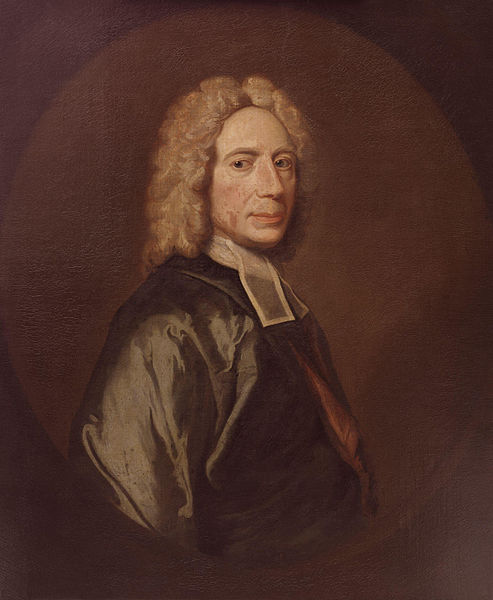
This is by far one of my favorite hymns for the season of Lent in the Christian tradition. The original hymn text was written by Isaac Watts (1674-1748)–one of the greatest hymn writers of the English language (more info here: http://en.wikipedia.org/wiki/Isaac_Watts). The modern refrain in this version was co-written in the year 2000 by JD Walt (Theologian, musician, professor of worship at Asbury Seminary–link here) along with Chris Tomlin and Jesse Reeves (two rather popular christian musicians–link here). The refrain adds a humble call to action and submission to ‘come and die’ with Christ during this season of lenten preparation for Holy Week. There is also an amount of light shining ever so slightly with hints of the resurrection Christ and resurrection for us–the promise of Easter.

Although a variety of tunes can be used for this Long Meter tune (8.8.8.8–that’s 8 syllables in 4 lines), the original tune ‘Hamburg’ (#298 in the United Methodist Hymnal) is still my favorite. Hamburg tune was written by Lowell Mason a prolific hymn tune composer who is responsible for many advancements in music education (wikipedia info here). For me, this musical setting carries with it the more helpful melodies and notes which convey the solemn, yet hopeful words and tone of this hymn, which many consider to be Watts’ finest and most recognized hymn.

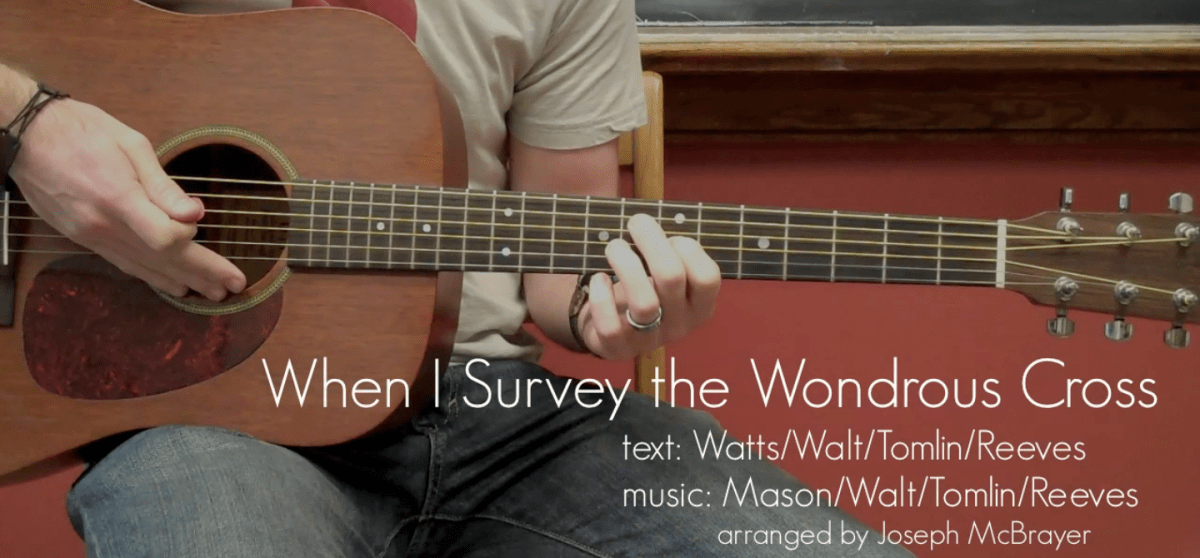
This is my own arrangement with the guitar tuned to DADGAG: a common Irish/Scottish/bluegrass tuning which allows for the playing of ‘melody’ while playing ‘rhythm.’

verse D Bm G D     D G A    D Bm G D    D G A D //  refrain  G  D/F# G  D/F# G  D/F# A  D

Church Music & Oh God our Help in Ages Past

I believe that there IS excellent, theologically diverse, musically interesting, contextually indigenous, and beautiful music out there–some of it helpful for Christian worship. The challenge as pastors and musicians is to seek it out, sort through it, exegete/dissect it, and make it work in our context/setting.

Let me first say that I’m very skeptical of much modern christian worship music. Secondly, I’m especially skeptical of the “Contemporary Christian Music Industry”–which appears to be mostly concerned with certain (most often very conservative) theological/social perspectives, the music’s ability to play on ‘pop-christian’ radio, and the its ability to sell–that is, to make money. When every band in all of musical Christendom comes out with a “christmas worship album” it is hard NOT to see the dollar signs overtaking and obscuring the Gospel–as well as the context and beauty of music. This is not simply the music industry’s fault, but also the blame lies in our tendency towards laziness and sticking to what we already know. I believe that there IS excellent, theologically diverse, musically interesting, contextually indigenous, and beautiful music out there–some of it helpful for Christian worship. The challenge as pastors and musicians is to seek it out, sort through it, exegete/dissect it, and make it work in our context/setting.

It seems like I’m always having conversations with other musicians, ministers, and college students about music–specifically in this case about WHERE to find good music for worship services in the Christian tradition. That’s at least in part of why I began writing here and posting recordings and thoughts on songs, theology, and media. One such source I’ve discovered is Sojourn Music from Sojourn Community Church in Louisville, KY. Sojourn is a great example of contextualized, indigenous, and thoughtful church community that produces EXCELLENT music and art. (I first heard about them while in seminary at Candler School of Theology at Emory University. Rev. Barbara Day Miller, Associate Dean of Worship and Music, gave me a set of their CD’s and an article about them she’d run across. I looked at the article and then listened to the music–it was excellent!) Their songs are influenced by variety of musical styles including blues, folk, gospel, and indie rock. After some further research I found that they are a member of the Southern Baptist Convention–a discovery which, as a moderate United Methodist, I found both shocking AND refreshing! Sojourn musicians have a fond appreciation for the hymns of Isaac Watts and do great justice to his words with the original music and with some new arrangements drawing on the native sounds of their context and congregations in Louisville. One of my favorites of their new musical arrangements is “Oh God Our Help in Ages Past” arranged by Brooks Ritter (a gifted musician and song writer with lots of play on Louisville local radio stations). Here is a link to their recorded version.

Finding good worship music is a part of the process–implementing it in a worship setting is often the next step: A few weeks ago we tried it out in worship with the college students at Emory Wesley Fellowship in our Sunday Night Worship service held at Glenn Memorial UMC on Emory’s campus. Here is the resulting recording with guitar, voice, and event some harmonica too.

Here’s Sojourn’s pdf of the chord sheet for Oh-God-Our-Help-in-Ages-Past

A Day of Prayer for Exploration 2011

Today is a day of prayer for Exploration 2011. Exploration is a gathering of people ages 18-26 who are discerning, wrestling, or just trying to figure out their call into ministry. It is a weekend of people gathering from all over the church to pray, worship, teach, learn, listen, and hang out with other people who are asking some of the same questions about ordained ministry in the United Methodist Church. Exploration 2011 will be held in St. Louis, MO at the Millenium Hotel  November 11-13. Registration is online and TODAY is the last day of earlybird registration!

And now, a prayer for exploration 2011:

God,
you know all people and you have made all people in your image,

 you love us and know us and we thank you for your love and call upon all of our lives:
for all of us: a call to work, live, and love people.

And today we especially pray for those who are discerning your call on their lives
to Ordained Ministry as Elders and Deacons in the United Methodist Church.
We pray that you would guide, equip, lead, and develop them into servants of the whole church and the whole world.

We pray for exploration 2011–that your Spirit will be obvious and apparent to all who gather.

In the name of Jesus the Christ, Amen.