This is my own interpretation of the Spiritual “There is a Balm In Giliead.” I spent much time in conversation with a good friend Rev. Michael A. Hunt about how to bring my style and who I am into the singing of a such a song…
This is my own interpretation of the Spiritual “There is a Balm In Gilead.” I spent much time in conversation with a good friend and accomplished singer, Rev. Michael A. Hunt, about how to bring my style of music and a bit of who I am into the singing of a such a song as Balm in Gilead.
It was recorded in preparation for a sermon for Emory Wesley Fellowship (http://emorywesley.org) and Glenn Memorial UMC (http://glennumc.org) in Atlanta, Georgia, USA on 09.18.10 in a chapel at Glenn Church on Emory University’s Campus.
“That ultimate message of hope and healing…is the product of creative tension between awareness of painful oppressive circumstances and the simultaneous envisioning of a hopeful future. This is not a naive optimism, but rather a genuine inner transformation.” Arthur C. Jones
This is a sermon I wrote and preached on Sept 19th, 2010 at the 8:30am Service at Glenn Memorial UMC in Atlanta, GA for Glenn-Emory Day. I really enjoyed working on this one–special thanks to Rev. Michael Hunt for his collaboration and help in interpreting and working with the Spiritual “There Is a Balm in Gilead.” Great quote from author & musician Arthur C. Jones about There is a Balm In Gilead: “That ultimate message of hope and healing…is the product of creative tension between awareness of painful oppressive circumstances and the simultaneous envisioning of a hopeful future. This is not a naive optimism, but rather a genuine inner transformation.”
This is my arrangement of the classic “doxology” or as it is better known: “Praise God from Whom All Blessings Flow” or “Old 100th”…or ‘the song they play after they take up the offering.’
It is number 95 in the United Methodist Hymnal (& public domain), but the “Old 100th” came from when the ‘hymnal’ used to only be filled with psalms set to music and this tune was from that 1551 arrangement attributed to Louis Bourgeois. The words for this text came from Thomas Ken (father of english hymn writing) and was written by him with the simple title (or instructions) “morning and evening hymn.”
This may sound strange, but I prefer to play it a safe distance away from the offering. When we do use it in worship (hardly ever near the offering, those in worship seem to grasp a different meaning of the tune and lyrics. The meaning of ‘Doxology‘ is actually from New Testament Greek for praise, honor, or glorify. We’ve settled with it being played at the time of the return of the offering to God (ushers bringing the plates back up to the front of the church altar/table) is because it has a good theological reason: we should give praise, honor, and glory to God in returning a portion of all that God has given us back to God’s kingdom and the work of the Lord. However, the a common result when we hear this song now is that we get an ever-so-strong sense that we should be standing, singing, and giving money.
All joking aside, this is a real example of tradition that needs to be RE-taught and RE-contextualized. I think that many people really do like this song (great history and excellent words and even theology) but it gets used in the church context only as ‘the song we sing after the offering.’ This is a short shrift for such a beautiful, powerful, and diverse song–it can be sung quietly as a prayerful evening hymn or loudly as an anthem at the 11 o’clock service.
This version uses a cut capo (simulates DADGAD by holding the strings in an Esus, which allows the guitar player to play ‘rhythm’ and ‘lead/melody’ at the same time).
Note the use of ‘God’ in lieu of ‘Him’ for greater inclusivity while retaining the Trinitarian and doctrinally important (Baptism/Eucharist rites & inter-denominational covenants/agreements) language of Father, Son, & Holy Ghost.
lyrics/chords:
E A2 Bsus E
Praise God From whom all Blessings Flow
E A B
Praise God all creatures here below
E A B E
Praise God above ye heavenly host
E A B E
Praise Father, Son, and Holy Ghost
(Cre-a-tor)
video of my sermon on Luke 24:44-53 (the Ascension of Jesus) May 16th, 2010 at Glenn Memorial UMC
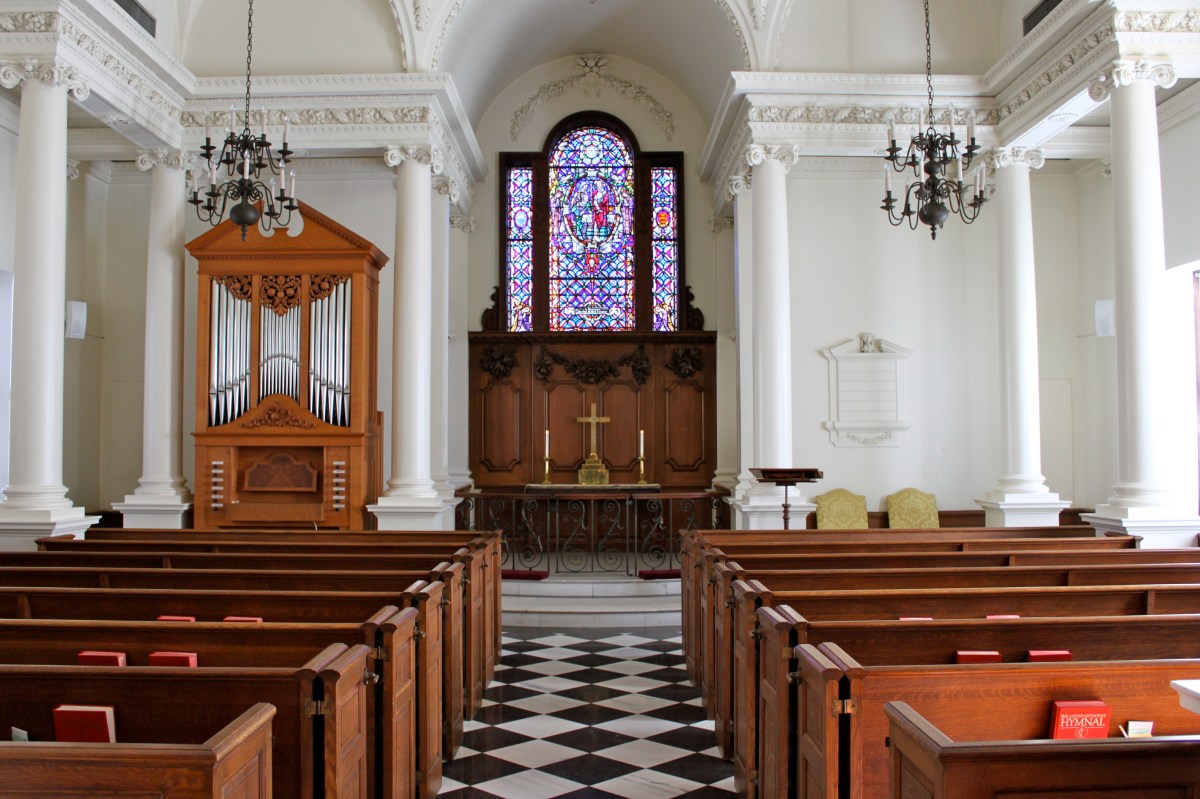
As friends, family, and students have requested, here is the video of my sermon on Luke 24:44-53 (the Ascension of Jesus) May 16th, 2010 at the 8:30am Worship Service at Glenn Memorial UMC (glennumc.org) in the Little Chapel. (the audio is not super awesome–sorry)
For a pdf of the sermon’s text, click here (no plagiarizing please)
a classic Lenten hymn used frequently during Holy Week
This passion hymn details the crucifixion story of Jesus and focus on the head of Christ. The words for this medieval hymn come from an anonymous 11th/12th century latin text that is thought to be written either by Bernard of Clairvaux or (more likely) Arnulf of Louvain. The text for O Sacred Head is from the last in a cycle of poems written about the wounds of Christ during the crucifixion (feet, knees, hands, sides, breast, heart, and head).* The hymn’s text pulls from images of the crucifixion as found in Matt 27:27-31, Mark 15:16-20, & John 19:1-5 where a crown of thorns is fashioned and placed on the head of Jesus by the guards who are beating and mocking him. It is a classic Lenten hymn and is used frequently on Maundy Thursday and Good Friday during Holy Week.
The hymn tune comes from Hans L Hassler (1601) and the harmony is by J.S. Bach and comes from his St. Matthew Passion, 1729. However, the tune and text were first matched together by Lutheran musician Johann Crüger in 1656. It later was included in several hymn collections and made its way into western Christianity’s hymnody.*
In the recorded version below I take some license with the musical arrangement and with the meter of the phrasing in this wonderful and ancient hymn of the western church. It can be found in the UMHymnal #286.
(*Many of the notes here are from a the resources and writings of a great United Methodist professor and theologian of church music, Carlton R. Young (editor of United Methodist Hymnal/Companion to the UM Hymnal) and from Diana Sanchez’s introductions to Hymns of the United Methodist Hymnal.)
a version my good friend Rev. Michael A. Hunt and I worked up in Spring of 2009
This is a version my good friend Rev. Michael A. Hunt and I worked up for a worship service at Candler School of Theology at Emory University in Spring of 2009. Michael is an excellent and accomplished singer and should be singing instead of me, but he is now in Iowa in work/ministry at Grinnell College. (you can read his blog here)
This song is an African American Spiritual and has deep roots in the black church tradition. As are many spirituals, this song is a prayer–but, as Michael puts it, it is not a prayer of someone who doesn’t think that Jesus is there, but it is a song that helps us to remember and have reaffirmed that fact that Jesus IS with us.
In worship settings it can be used for congregational song or for use as a special music or solo/duet. In this version, the guitar is tuned a 1/2 step down (Eflat) for a more blues-like sound (it can go another whole step down if needed/desired).
It is a suitable song and prayer for the liturgical season of Lent (40 days before Easter) in the Church year and is a fitting song to sing when you’re going through the trials and troubles of life.
a great setting of the Lord’s prayer by singer/songwriter Matt Maher
The lyrics of this song come from Psalm 40 (sing a new song) and Matthew 6 (the Lord’s prayer) as penned by Catholic singer/songwriter Matt Maher (http://mattmahermusic.com) in collaboration with Ed Cash (accomplished singer/songwriter/songcompleter in the christian music/worship realm).
In the process of writing and rewriting this song, Maher writes that he hopes that this song can be one that emphasizes the unity of the Christian faith as all traditions utilize some form of the Lord’s prayer as found in the Sermon on the Mount in Matthew 5-7.
It gives me hope for the future of church music (and the church) when worship leaders and musicians use ancient words with modern arrangements that have such a high degree of liturgical and practical significance–such as this song. This gives me hope–hope that the Church can move beyond the extremes of traditionalism (tradition for its own sake) and the misunderstanding/denial of traditions & people who have come before us. I have hope that the Church can continue to express the Christian faith in ways that embrace the ancient, liturgical, & traditional elements of our past while engaging with the modern/post-modern/future elements of our current cultural climate and our contextual understanding of Christianity. Music and worship like what Matt Maher and Marty Reardon (see post below) are doing is giving deeper context and meaning to ancient liturgical words and practices that enable people to gain a deeper understanding of the Christian faith and tradition. May others continue to do so.
Maher is also the author of the popular song “Your Grace is Enough.” One of my favorites from the album “Alive Again” is a deep, meaningful, & liturgical song: “Christ is Risen From the Dead”, which uses the Eastern Orthodox phrase from the Pascha (Easter) “Christ is risen from the dead/trampling over death by death.” It will likely show up here later this liturgical year.
written by the worship team at Trinity Anglican Mission in Atlanta, Ga with worship pastor Martin Reardon
This song is written by the worship team at Trinity Anglican Mission in Atlanta, Ga where worship pastor Martin Reardon and other gifted leaders work and serve. Reardon is an excellent musician, writer, and a down-to-earth, genuine guy with a longing for worship music that connects to the liturgy of the service (more of Martin on youtube).
This song comes from the “Prayers of the Saints” CD that they put out in 2006. My good friend Jarrett Dickey (http://fiveriverschurchplant.blogspot.com), who worked at Trinity during seminary brought this song (and many others) to my attention. I have greatly enjoyed getting to know Marty, the good people at Trinity, and their carefully crafted music. (please check out excellent worship music site http://www.trinityworshipmusic.org )
At the Emory Wesley Fellowship, the United Methodist Campus Ministry at Emory University, we sing this song often during communion because of the simple, but profound words and melody and the meaning behind them. The worship team (cello, mandolin, piano, drums & guitar) have a great time with St. Thomas.
The text of this song is adapted from a Eucharistic prayer of St. Thomas Aquinas (12th century) and with its modern musical setting can used from a prayerful, solemn vibe to a medium tempo setting of simply offering thanks to God. There are much better recordings out there, but this should give you an idea of how it can be played and done.
a favorite for the opening of worship and is widely sung as an Trinitarian ecumenical hymn
This hymn is a favorite for the opening of worship on Sunday mornings for many congregations but is also widely sung as an ecumenical hymn due to its circulation and familiarity in multiple contexts.
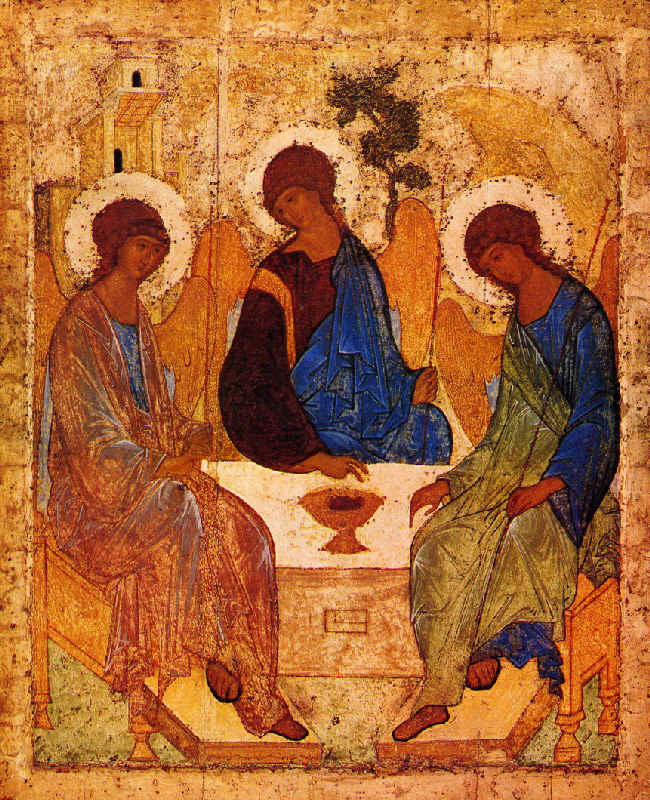
The author intended this hymn’s text to be sung following the saying of the Nicene Creed on Trinity Sunday and draws from the biblical imagery of Revelation 4:8-11 and Isaiah 6. In the early 20th century, this text, with its current hymn tune was recommended to be used in celebrating Communion and is often still used for this purpose. (Rublev’s Icon of the Trinity from 14th century Russia at right).
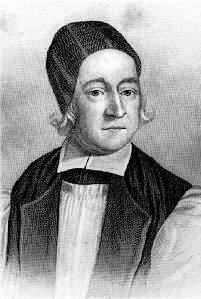
Heber was an Anglican priest and bishop of Calcutta in India and was a well known hymn writer. This hymn can be found in the United Methodist Hymnal #64 along with other hymns he penned including “Bread of the World” UMH #688.
The imagery and language of this hymn is Trinitarian in its scope and invites those who are singing into a space to worship and praise God. For me, this hymn is one of many examples of hymns whose content and musicality can still translate and be brought into our post-modern context (barring a few exchanges of “wert” for “were”). This is a “classic” hymn in my book and one that can unite people from various traditions, backgrounds, and experiences in worship of our Triune God.









 Rev. Dr. Joseph McBrayer